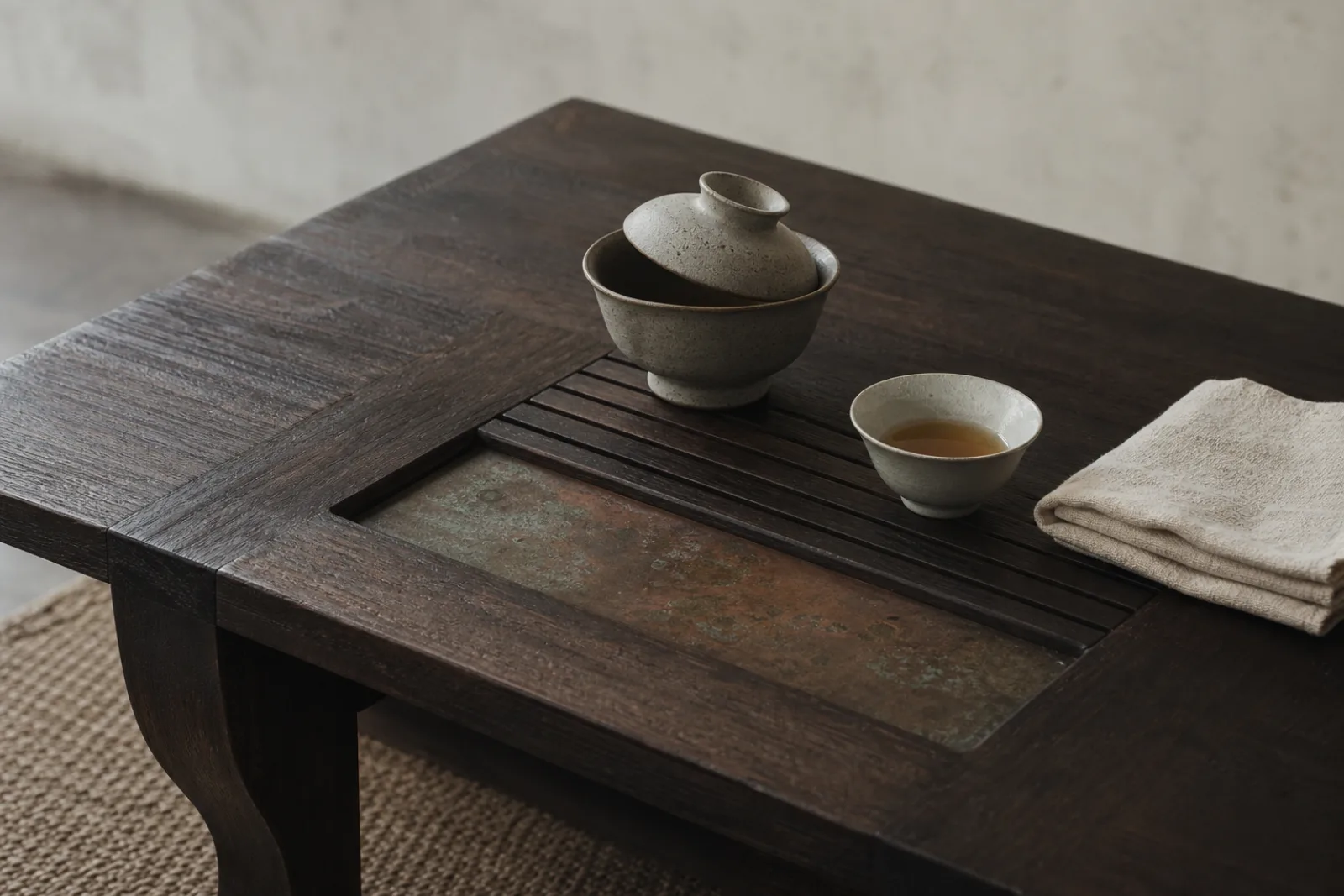
From tea taster to furniture curator
Sandry Law’s relationship with tea began not in a classroom but on the tasting floors of Yunnan’s raw pu-erh factories. Early in his career, he worked alongside master blenders in Menghai, learning to detect the whisper-thin differences between spring and autumn leaves, sun-dried and shade-withered maocha. That sensory discipline — spotting nuance in a sea of variables — laid the foundation for a procurement philosophy rooted in patience, precision, and deep respect for craftsmanship.
By the time Teamotea brought him on as Head of Procurement (China), Sandry had already cultivated a network of trusted growers and processors across Yunnan, Sichuan, and Fujian. His role expanded naturally from tea leaves to tea culture: the vessels, the tables, the spaces that complete a ceremony. He saw that a poorly chosen chá pán could disrupt the same gōngfu rhythm he’d spent years perfecting, while a thoughtfully designed low table could quiet the mind before the first pour.
That insight led him to tea.furniture. Today, Sandry travels between Kunming’s bustling commodity markets and quiet ateliers abroad, sourcing the Saint Petersburg cabinetmaker line — a partnership he nurtured from first sketch to final oil finish. He hand-selects each walnut gongfu table and cedar cake shelf, not merely for aesthetics but for how they age, how they drain, how they feel under the palm during a long session. Every piece is vetted for the demands of daily practice: heat resistance near a stove, moisture tolerance near a sink, joinery that stays silent for decades.
In his Kunming office, shelves hold not just tea samples but wood blocks, finish swatches, and prototypes. He often invites local tea masters to test new designs mid-session, observing how a table’s height or a shelf’s depth influences the flow of brewing. For Sandry, procurement is never anonymous — it is a continuous conversation between maker, material, and the person who will one day kneel before it with a kettle in hand.
Kunming — the procurement nerve centre
Kunming is not a tea farm, but it is the great gathering point — the city where Yunnan’s ancient tea mountains funnel their harvests, and where Sandry Law built his procurement practice. Perched at 1,900 metres on the Yunnan-Guizhou Plateau, Kunming enjoys a mild climate that preserves everything from raw pu-erh to delicate wood stock, making it an ideal logistics base for both tea and furniture.
The city’s markets are a living atlas of materials. Wander through the Yunnan Wood Trade Market and you’ll find walnut slabs from Dali, cedar from Lincang, and occasionally reclaimed beams from dismantled Qing-era homes. Sandry moves through these alleys with the quiet familiarity of someone who has spent years learning which timberyards cure their stock properly and which workshops cut corners on dovetail angles. That knowledge feeds directly into the Saint Petersburg line — particularly the 120cm walnut gongfu table, whose wood is selected for straight grain and natural oil content, ensuring it performs equally well in Kunming’s dry winter air and Singapore’s humid afternoons.
Beyond materials, Kunming offers a cultural bridge. The city sits at the crossroads of the old Tea Horse Road, a route that once carried fermented tea bricks to Tibet and beyond. That heritage infuses the procurement mindset: source for permanence, not for trend. Sandry’s work for tea.furniture mirrors this — each piece must survive not just a single ceremony but a lifetime of brewing, rinsing, and quiet appreciation.